🧭 What Kind of Person Am I? Quiz
The "What Kind of Person Am I?" quiz matches you to one of six personality types — Anchor, Spark, Cartographer, Lighthouse, Wildcard or Weaver — using eight questions about how you decide, recharge and react under pressure. Ninety seconds, instant result, every outcome listed below before you start.
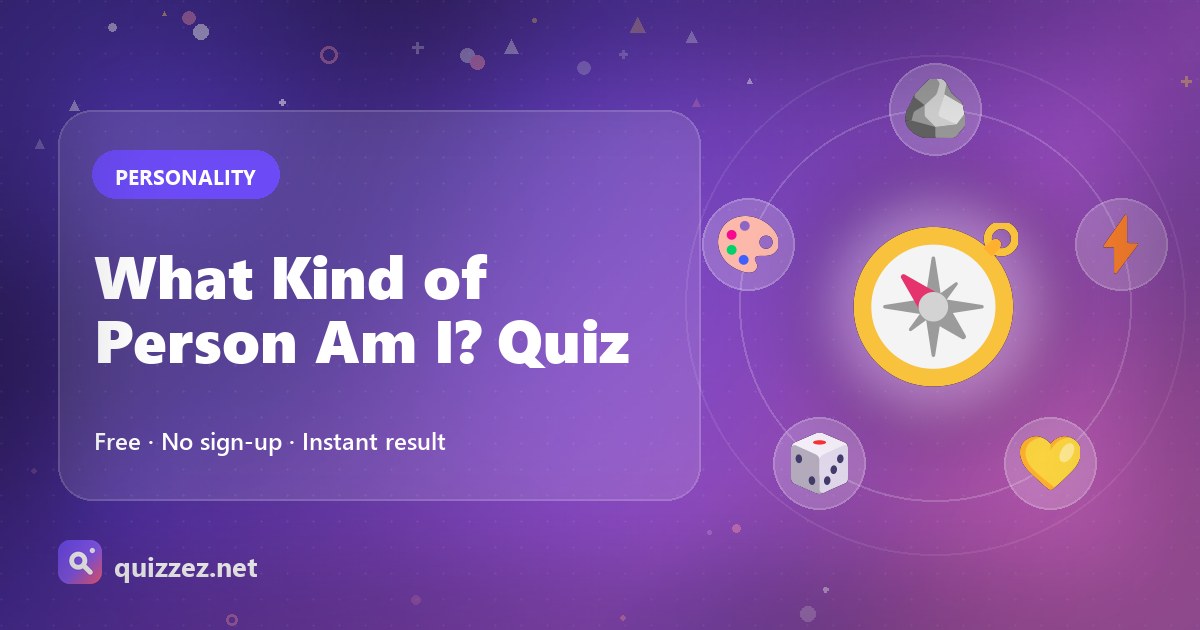
How the quiz works
Eight questions score you across six types. Each question probes one of four dimensions: where your energy comes from, what tips your decisions, how you handle pressure, and how other people read you. Your highest-scoring type is your result; your second-highest is your streak.
The questions are deliberately behavioural rather than self-descriptive. Nobody answers “are you kind?” honestly — everybody says yes. So instead you’re asked what you actually do when a group chat lights up, when a friend brings you a problem, when something breaks at the last minute, and what people most often get wrong about you.
The stress question carries real weight, because stress strips the performance off. Plenty of people look like a Spark on a good day and turn into an Anchor the moment things go sideways — and the one you become under pressure is usually the truer one.
What each result means
| Result | Core trait | Blind spot |
|---|---|---|
| The Anchor 🪨 | Steady, dependable, unshakeable in a crisis | Absorbs everyone’s weight and never asks for help |
| The Spark ⚡ | Fast, warm, turns a room on | Starts more than it finishes; struggles with quiet |
| The Cartographer 🧭 | Analytical, pattern-hunting, wants the full map | Confuses “more information” with “ready to act” |
| The Lighthouse 💛 | Attuned, safe to talk to, notices the quiet one | Reads everyone’s needs except its own |
| The Wildcard 🎲 | Bold, curious, moves before fear catches up | Mistakes restlessness for growth |
| The Weaver 🎨 | Imaginative, meaning-driven, sees the story underneath | Lives in the imagined version instead of the real one |
What the table can’t show is that these types cluster in predictable pairs, and the pairing changes how the type actually feels from the inside. An Anchor with a Lighthouse streak is the person the whole family calls; an Anchor with a Cartographer streak is the one who fixes the problem and forgets to mention it. Same core, completely different experience of being that person.
How to read a tie or a close result
A close score isn’t a broken result — it’s usually the most accurate thing the quiz tells you. If your top two are within a few points, you genuinely operate as both, and which one shows up depends on the room. Read both descriptions and notice which blind spot stings more; that one is your primary. The type you’d rather be is almost never the one you are.
Some pairs are stable and some are a tug-of-war. Anchor and Cartographer sit comfortably together — both want solid ground. Wildcard and Anchor is the friction pairing: the part of you that wants to leave and the part that keeps its promises, arguing on a loop. Spark and Weaver often show up in people who look extroverted publicly and need total solitude to reset. If that’s you, the exhaustion isn’t a flaw in your personality, it’s the cost of running two engines.
Is it accurate?
Honest answer: it’s accurate about your patterns, not your identity. Eight questions can reliably surface how you tend to decide, recharge and respond to pressure, because those habits are consistent enough to show up in your answers. What it cannot do is measure your values, your intelligence, your mental health, or who you’ll be in five years.
This isn’t a clinical instrument and it isn’t validated psychometrics — it’s a well-built entertainment quiz that tries not to insult you. It has two known limits worth naming. First, it reads your current season, not your permanent wiring; answer it during a hard month and you’ll skew toward Anchor. Second, it measures how you see yourself acting, which is not always how others experience you — the fastest sanity check is to have someone who knows you well guess your type before you tell them. When their guess and your result disagree, the gap between the two is the genuinely interesting part.
Keep going — see am i a good person · try the what type of person am i quiz · find out which stranger things character are you.
How seriously should you take this?
This quiz is built for fun and self-reflection, not for professional assessment. It is not a diagnosis and can't replace advice from a qualified doctor, therapist, or counsellor. Results are based on the answers you pick in the moment — pick different answers and you'll get a different outcome. If something here worries you about your health or wellbeing, please talk to a professional.
Frequently asked questions
How many questions is the What Kind of Person Am I quiz?
Eight questions, roughly ninety seconds. Each one has four answers, and every answer scores toward one of the six types. Eight is enough to separate types that overlap, like Anchor and Cartographer, without turning a fun quiz into an assessment you abandon halfway through.
What are the possible results?
Six: The Anchor (steady and dependable), The Spark (fast and energising), The Cartographer (analytical and thorough), The Lighthouse (attuned and emotionally safe), The Wildcard (bold and curious), and The Weaver (imaginative and meaning-driven). Every one is listed above with its strength and its blind spot, so nothing is hidden behind a click.
Is this the same as a personality test like MBTI?
No. A personality test is a validated instrument built to be scored consistently over time; this is a personality quiz built to be insightful and enjoyable. MBTI-style tools sort you on fixed dimensions and take twenty minutes or more. This reads your current behavioural patterns in ninety seconds and calls itself a snapshot.
Can I get two types at once?
Effectively yes, and most people do. The quiz names your highest-scoring type as your result and your second-highest as your streak — you're an Anchor with a Wildcard streak, or a Lighthouse with a Weaver streak. If the top two are within a few points, treat both descriptions as true and let context decide which shows up.
Why did I get a different result than I expected?
Usually because the quiz asks what you do rather than what you're like, and those diverge. People who think of themselves as spontaneous often answer every stress question like an Anchor. The stress and last-minute-problem questions carry real weight precisely because pressure strips off the version of yourself you've practised.
How accurate are personality quizzes generally?
Good ones are accurate about patterns and useless as diagnosis. Any quiz claiming to be 100% accurate is selling you certainty it can't produce. Judge a result by whether it names a blind spot you recognise and slightly resent — that's the sign it caught a real pattern rather than flattering you.