🎂 How Rare Is My Birthday? Quiz
The "how rare is my birthday?" quiz asks for your actual birth date — month, position in the month, leap-day status and holiday overlap — then returns a rarity tier from Peak Season Popular to Leap Day Legend, with a plain-English reason your date lands where it does.
How the quiz works
Birthday rarity depends on one thing: your date. So this quiz actually asks for it. Four questions pin down your month, your position in the month, leap-day status and holiday overlap; four more read your birthday personality. Eight questions, about ninety seconds, instant tier.
That sounds obvious, but plenty of “birthday rarity” quizzes never ask for a date at all — they ask about cake preferences and party styles, which cannot produce a rarity figure by any mechanism. If a quiz never learns your date, its answer is decoration. Ours separates the two cleanly: the four date questions decide your tier, and the personality questions only colour the write-up you get at the end.
What each result means
Tiers reflect well-documented patterns in US birth records: late-summer and September dates cluster at the top, spring and midwinter sit lower, and the days around Christmas and New Year thin out because scheduled inductions and C-sections tend to get moved off the holidays. September’s density is usually traced back to conceptions the previous December.
| Result | What drives it |
|---|---|
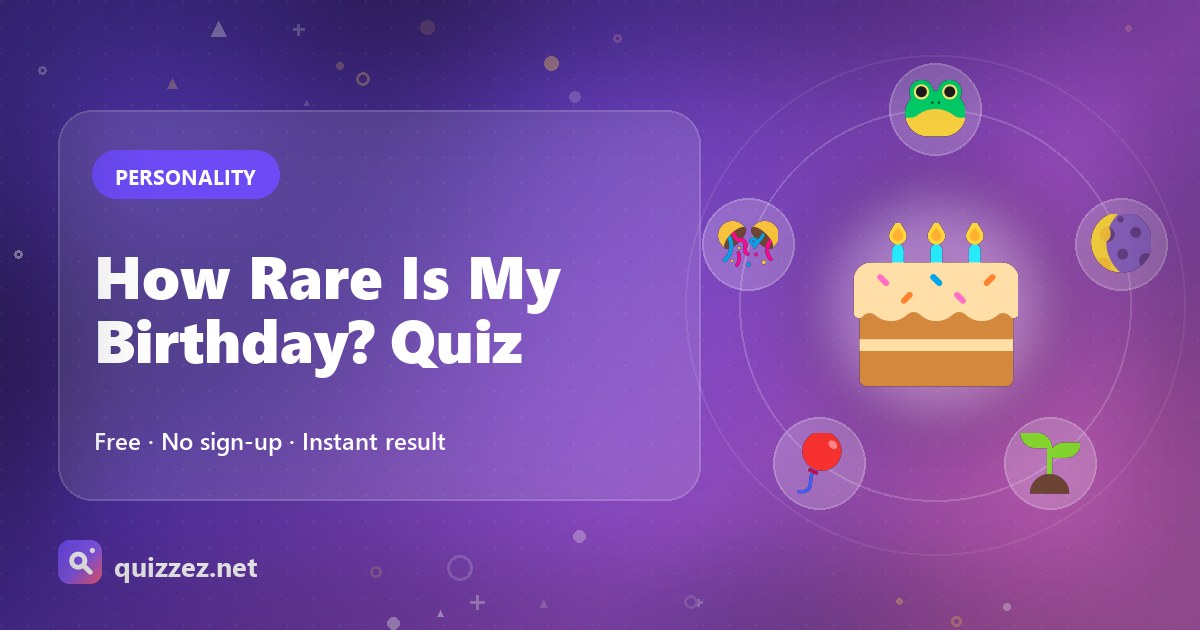
| Leap Day Legend 🐸 | February 29 — exists once every four years |
| Genuinely Rare 🌘 | Holiday-adjacent or late-December/January date |
| Quietly Uncommon 🌱 | Spring or month’s-end date, thinner crowd |
| Comfortably Common 🎈 | Summer or autumn date, steady popularity |
| Peak Season Popular 🎊 | Mid-September territory, the densest stretch |
Is it accurate?
Honestly: directionally yes, dramatically no — and pages promising a precise “global rank” are overselling. Here is the part nobody states. Every non-leap date sits within a whisker of 1 in 365. The gap between the densest date and the sparsest ordinary date is real but modest — a matter of a few percent to a few-fold, not hundreds. So “rare” here means slightly less crowded, not one-of-a-kind.
Two more limits worth knowing. First, these patterns come from US birth data; rarity shifts by country and by decade, and the September-9-is-most-common anchor everyone repeats is US-specific. Second, February 29 is rare for calendar reasons alone — the date simply doesn’t exist three years in four. That says nothing about you as a person. Treat this as entertainment with a real basis underneath, not a statistic to quote in an argument.
Keep going — see how rare am i · try the how tall will i be quiz · find out which stranger things character are you.
How seriously should you take this?
This quiz is built for fun and self-reflection, not for professional assessment. It is not a diagnosis and can't replace advice from a qualified doctor, therapist, or counsellor. Results are based on the answers you pick in the moment — pick different answers and you'll get a different outcome. If something here worries you about your health or wellbeing, please talk to a professional.
Frequently asked questions
What is the rarest birthday?
February 29. It only exists in leap years, so it appears roughly a quarter as often as any other date. Among dates that occur every year, December 25 and January 1 are consistently among the least common in US records, largely because planned deliveries get scheduled away from major holidays.
What is the most common birthday?
In US birth data, mid-September dates — September 9 is the figure most often cited — sit at the top, with the whole late-August-to-late-September stretch running dense. The usual explanation is conception clustering around the previous December holiday period.
How many people share my birthday?
Roughly 1 in 365 people worldwide, give or take. On a common date that nudges slightly above; on a sparse one, slightly below. In a room of 23 people there's about a 50% chance two share a birthday — that's the classic birthday paradox, and it surprises almost everyone.
Does the quiz work for February 29?
Yes. Question three asks directly whether you were born on leap day, and answering yes routes you straight to the Leap Day Legend tier regardless of your other answers — because on rarity, that single fact outweighs everything else.
Do you store my birth date?
No. Nothing is stored, and there's no sign-up. The quiz never asks for your birth year either, so there's no date-of-birth record being created — your answers exist only in your browser while you take it.