💞 How We Love Quiz
The "How We Love" quiz identifies your love style — the pattern you fall into when you feel close, criticised or disconnected. Twelve honest questions sort you into Avoider, Pleaser, Vacillator, Controller, Victim or Secure Connector, in under three minutes.
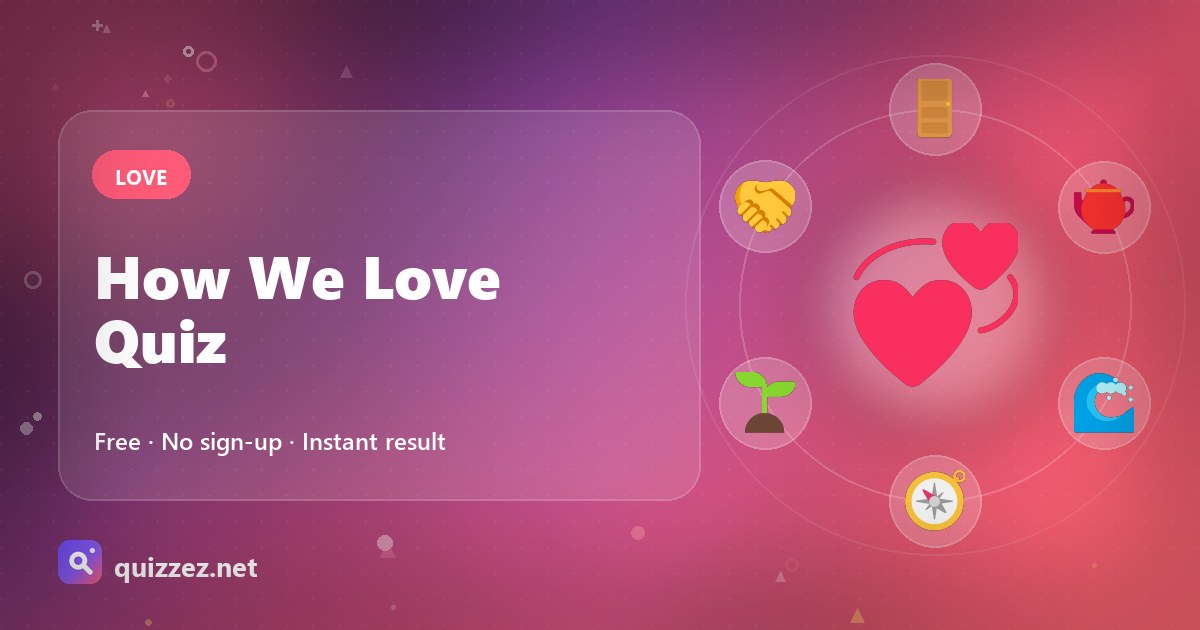
How the quiz works
You answer 12 everyday scenarios — a hard day, a cancelled plan, a silence in the car — and pick the reaction that’s honestly yours, not the one you wish were. Each answer feeds one of six love styles, and the highest score wins. No sign-up, no email, and no 25-question marathon you have to finish in one sitting.
One thing nobody explains: three different frameworks share this search. Love styles (the five patterns in the table below, plus secure connection) describe how you behave when connection feels threatened. Attachment styles — secure, anxious, avoidant, disorganised — are the research vocabulary underneath them. Love languages are something else entirely: how you like affection delivered. This quiz is the first one, and the styles map loosely onto attachment language, which is why “Secure Connector” sits at the end of the list.
What each result means
Every style is a survival strategy that once worked. None of them is the bad one, and none of them is permanent — the Secure Connector is a destination people walk toward, not a personality you’re issued at birth.
| Love style | Core move | Growth edge |
|---|---|---|
| The Avoider 🚪 | Handles it alone | Name one feeling out loud |
| The Pleaser 🫖 | Keeps the peace | Risk a small honest “no” |
| The Vacillator 🌊 | Comes close, then braces | Stay through small letdowns |
| The Controller 🧭 | Takes charge fast | Let someone see you unsure |
| The Victim 🌱 | Stays small and safe | Say the preference out loud |
| Secure Connector 🤝 | Close without disappearing | Keep repairing early |
Is it accurate?
It’s accurate the way a good mirror is accurate — it reflects what you already half-know, in language you can use tonight. What it genuinely cannot do: diagnose anything, read your childhood, score your partner, or predict whether a relationship lasts. A 12-question self-report captures how you think you behave, and most of us are generous narrators about that.
Two honest caveats. Scores shift with the season you’re in — stress, a new relationship or a rough year can pull you toward a style that isn’t your baseline. And plenty of people land almost evenly between two styles, which usually means both are true depending on who you’re with. Treat the result as a conversation starter with someone you love, not a verdict. If old patterns are actively hurting you, a therapist beats any quiz on the internet.
Keep going — see am i in love · try the how many people have a crush on me quiz · find out who is my guardian angel.
How seriously should you take this?
This quiz is built for fun and self-reflection, not for professional assessment. It is not a diagnosis and can't replace advice from a qualified doctor, therapist, or counsellor. Results are based on the answers you pick in the moment — pick different answers and you'll get a different outcome. If something here worries you about your health or wellbeing, please talk to a professional.
Frequently asked questions
What are the five love styles?
The Avoider, the Pleaser, the Vacillator, the Controller and the Victim. A sixth outcome, the Secure Connector, is the healthy end state most people grow toward rather than a style they start with.
Is this quiz free and how long does it take?
Completely free, no email or sign-up. Twelve questions, about two to three minutes. You can leave and come back — nothing forces you to finish in one sitting.
What's the difference between a love style and an attachment style?
Attachment style is the research language (secure, anxious, avoidant, disorganised) for how you bond. Love style is the everyday behaviour that grows out of it — what you actually do when you feel unloved or crowded.
Can your love style change over time?
Yes. Styles are learned patterns, not fixed traits. Consistent safe relationships, honest conflict repair and sometimes therapy move people toward secure connection — often called earned security.
Can couples take it together?
Absolutely, and it's the most useful way to use it. Take it separately, then compare. The interesting part isn't your label — it's what happens when your two styles collide in an argument.