🚩 What Are My Red Flags? Quiz
The "What Are My Red Flags?" quiz reveals the habit you bring into relationships when you're stressed, scared, or falling fast. Eight honest questions, six named archetypes you can preview below, and a green-flag counterpart plus a repair step for every result.
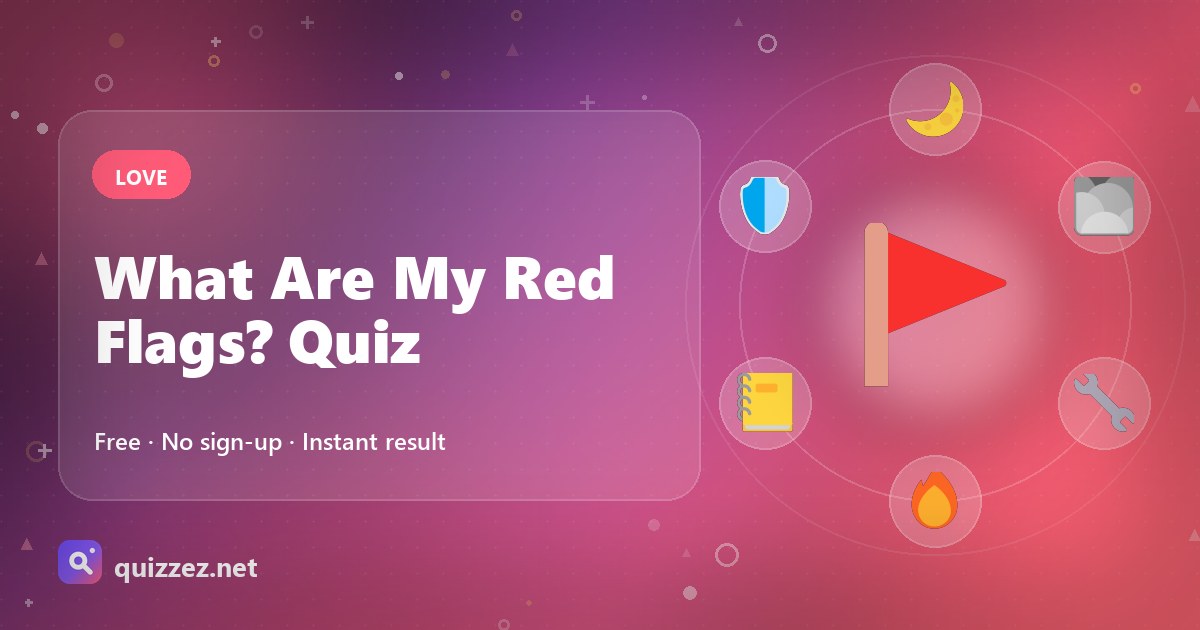
How the quiz works
You answer eight scenario questions about texting, conflict, pacing, and what your exes would say about you. Every answer adds points to one of six red-flag archetypes, and the one with the most points wins. It takes about two minutes, needs no email, and points at your own patterns — not your partner’s.
Most red-flag quizzes hide their results until you finish, so the payoff feels random. Ours are listed up front. If you already recognise yourself in one, that’s the quiz working early.
Answer as the version of you that shows up when you actually like someone, not the calm version you are with people you feel nothing for. Red flags almost never appear when the stakes are low.
What each result means
Every archetype pairs a warning sign with the strength underneath it, because almost no red flag is pure damage — most are a good instinct running at the wrong volume.
| Result | Your red flag | The green flag inside it |
|---|---|---|
| The Midnight Overthinker 🌙 | Reassurance-seeking, mind-reading | Emotionally attentive |
| The Vanishing Act 🌫️ | Withdrawing instead of saying it | Calm under pressure |
| The Fixer 🔧 | Loving potential over the person | Genuinely, reliably generous |
| The Fast Burner 🔥 | Intensity mistaken for intimacy | Wholehearted, never lukewarm |
| The Scorekeeper 📒 | Keeping receipts, fairness as a weapon | Fierce sense of justice |
| The Guarded Gatekeeper 🛡️ | Testing people, scanning for proof | Excellent instincts, real standards |
Scoring close between two archetypes is common and usually honest: plenty of people overthink for a week and then vanish. Read both descriptions and keep whichever one your gut argues with hardest.
Is it accurate?
It’s accurate the way a good friend is accurate: it names something you probably half-knew. Eight questions can’t diagnose anything, and this is entertainment and self-reflection, not therapy or a clinical assessment. If your answers were shaped by one particular relationship, you may get that relationship’s version of you rather than your baseline.
Two honest limits worth naming. First, a red flag is a pattern, not a single bad night — everyone withdraws or over-texts occasionally. Second, hypervigilance is its own trap: reading normal human imperfection as a warning sign will end good relationships as fast as ignoring real ones. If you scored as the Guarded Gatekeeper, that caveat is doing double duty for you.
Read your result, take the one small action it suggests, and treat the label as a conversation starter — with yourself, or with someone who already loves you.
Keep going — see does he like me · try the am i in love quiz · find out who is my guardian angel.
How seriously should you take this?
This quiz is built for fun and self-reflection, not for professional assessment. It is not a diagnosis and can't replace advice from a qualified doctor, therapist, or counsellor. Results are based on the answers you pick in the moment — pick different answers and you'll get a different outcome. If something here worries you about your health or wellbeing, please talk to a professional.
Frequently asked questions
How do I identify my own red flags?
Look at endings, not beginnings. Ask what your last two or three relationships had in common that you were present for — the same argument, the same complaint from different people, the same point where you pulled away. Repeated feedback from people who liked you is the clearest signal.
What's the difference between a red flag and a green flag?
A red flag is a pattern that predictably costs the relationship something — withdrawal, control, score-keeping. A green flag is a pattern that reliably builds trust, like repairing after a fight or saying what you need plainly. Most red flags are a green flag turned up far too loud.
Can you actually fix your red flags?
Yes, though "fix" usually means "downgrade to a yellow flag you can name out loud." Habits shift when you catch them in the moment and choose one different response — pausing before the third text, saying "I'm overwhelmed" instead of going quiet. Progress looks like faster recovery, not perfection.
Is a red flag always a reason to break up?
No. Dealbreakers — anything abusive, controlling, or dishonest — are non-negotiable. But most red flags are unskilled behaviour rather than danger, and someone who hears the feedback, takes it seriously, and changes something is showing you one of the best green flags there is.
What are yellow flags?
Yellow flags are the maybes: worth watching, not worth panicking over. Moving slightly too fast, being vague about plans, going a bit quiet during stress. They turn red when they repeat after you've named them, and fade when the person adjusts.