💔 Will My Ex Come Back? Quiz
The "Will my ex come back?" quiz reads eight honest signals — who initiates contact, how it ended, whether anything has actually changed — and returns one of five named readings instead of a vague percentage. Free, no email required, about two minutes.
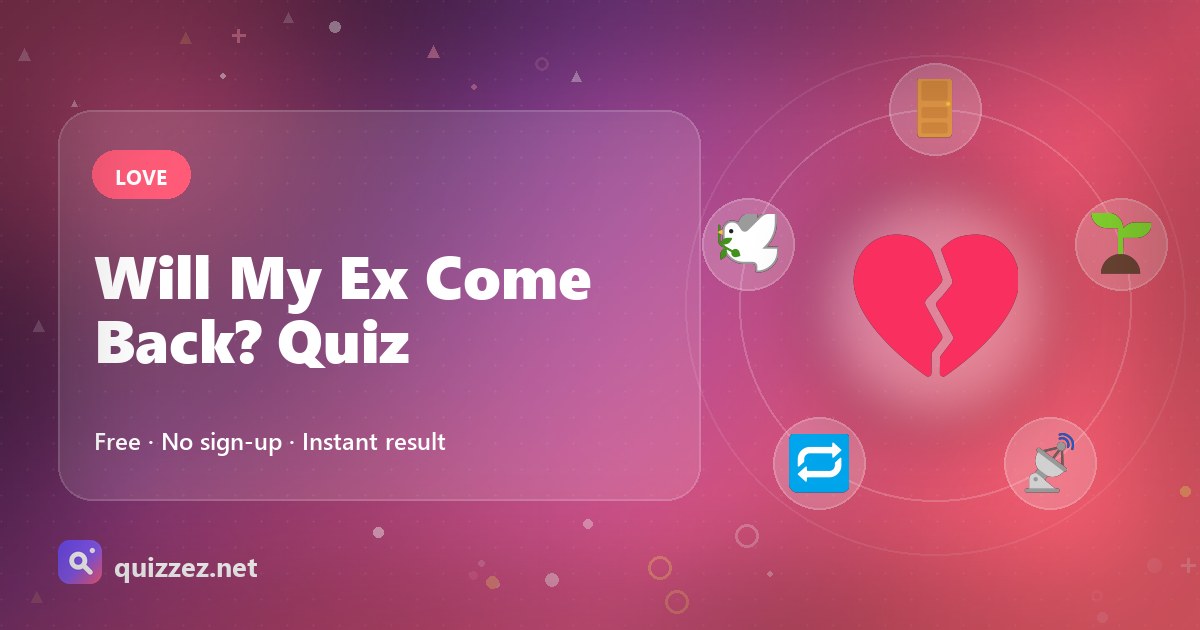
How this quiz actually works
Eight questions score five weighted signals, and the highest-scoring one becomes your reading. The heaviest is contact direction — not how often you two talk, but who starts it and at what hour. Unprompted daytime contact from them moves the score more than any other single input; late-night-only contact moves it somewhere else entirely.
The second is cause type. Breakups caused by circumstance (distance, timing, life stage) score very differently from breakups caused by a broken boundary or broken trust, because only one of those two categories resolves on its own. Third is trajectory over time: three weeks of silence and eleven months of silence mean opposite things, so elapsed time is read against whether contact is warming or cooling, never on its own. Fourth is replacement — a new partner, a rebound, or unresolved physical contact each pull the score in a different direction, and the third one is the most commonly misread. Fifth is change evidence: has the specific thing that broke you two been addressed by anybody, or did you simply stop discussing it?
Answers that describe your ex’s behaviour count for more than answers that describe your feelings. That is deliberate. Your hope is real, but it isn’t data about them.
What each result means
| Result | What it’s reading | Blind spot to watch |
|---|---|---|
| The Open Door 🚪 | They initiate, they use future tense, the split was circumstantial | An open door is not a decision — it can stay open forever |
| The Slow Thaw 🌱 | Contact has restarted but stays shallow and practical | Pushing for a defining conversation collapses it fastest |
| The Static Signal 📡 | Hot-then-cold behaviour with no stated position from them | Ambiguity feels like a clue; usually it’s just noise |
| The Loop 🔁 | Repeat breakups, night contact, closeness without commitment | Proximity gets mistaken for progress |
| The Clean Break 🕊️ | They’ve stated a position, moved on, or gone fully quiet | Reading their silence as strategy rather than an answer |
Four of these five are unstable readings — only The Clean Break is settled. That is worth knowing before you screenshot your result, because The Open Door, The Slow Thaw and The Static Signal can all become a Clean Break in six weeks if nothing changes, and The Loop is the one reading that can stay exactly where it is for years while feeling like it’s about to resolve any day.
Which signals actually mean something
Most people rank the signals wrong, so here’s the honest hierarchy. Unprompted contact outranks warm contact. An ex who replies affectionately to your message is telling you they’re not hostile; an ex who texts you first on a Tuesday afternoon about nothing is telling you they’re still oriented toward you.
Future tense outranks nostalgia. “Remember the trip to the coast” is grief. “You’d love the place that opened near me” is a person still placing you in their life. Nostalgia is the most over-read signal in every breakup, because it’s the one exes give most freely.
Stated positions outrank behaviour. If they have said out loud that they don’t see you two getting back together, that sentence outweighs every story view, every drunk text and every mutual friend’s report. People rarely say that unless they mean it, and the ones who change their minds usually change them for reasons you can’t manufacture.
Logistics prove nothing. Shared pets, leases, deposits and work chats generate contact that looks like interest and isn’t. Strip out every message that had a practical excuse attached, then look at what’s left. That remainder is your real signal count.
Is it accurate?
Here is exactly what this is and isn’t. It reads the signals you report — it has no access to your ex’s mind, and it cannot see the conversation they had with their best friend last week. If you answer generously because you want a particular reading, you’ll get that reading and it will be worthless. Answer as if you were describing someone else’s breakup.
It also can’t predict the two things that change these outcomes most: someone’s next relationship going badly, and someone doing genuine work on themselves. Both arrive without warning and both flip the reading completely. And a low score is not a verdict on you or on whether you were loved. It’s a description of where two people currently stand, and where people stand is the least permanent thing about them. Treat this as a mirror for signals you already half-noticed — entertainment and clarity, not a prophecy.
Keep going — see does my crush like me back · try the does he like me quiz · find out who is my guardian angel.
How seriously should you take this?
This quiz is built for fun and self-reflection, not for professional assessment. It is not a diagnosis and can't replace advice from a qualified doctor, therapist, or counsellor. Results are based on the answers you pick in the moment — pick different answers and you'll get a different outcome. If something here worries you about your health or wellbeing, please talk to a professional.
Frequently asked questions
How accurate is this quiz?
It's as accurate as your answers are honest. It scores the signals you report — contact direction, breakup cause, elapsed time, new partners and evidence of change — against how those signals usually behave. It can't read your ex's mind or predict the two biggest wildcards: their next relationship, and either of you genuinely changing.
Do exes actually come back?
Some do, and the ones who do tend to share a pattern: the breakup was caused by circumstances rather than a broken boundary, both people had real separation afterwards, and at least one person changed something concrete. Exes almost never return to the exact relationship that ended — they return to a renegotiated one, or not at all.
How long does it take for an ex to come back?
There's no reliable clock, but the shape is more useful than the timeline. Reconciliations usually follow a period of genuine distance rather than continuous contact, and they start with something small and unprompted rather than a grand declaration. If nothing has shifted after several months of real separation, the reading is drifting toward settled.
What is the no contact rule, and does it work?
It means no calls, texts, story views or check-ins for a set stretch — commonly about a month — while you rebuild your own footing. It works less as a tactic to make someone miss you and more as a way to stop generating fake signals: contact you initiate tells you nothing about whether they'd have reached out.
Should I contact my ex first?
If the goal is information, no — your message contaminates the data, because any reply tells you they're polite, not that they're interested. If the goal is closure on something specific and unresolved, one clear, short message is reasonable. The long explaining message is the one people regret most, and it rarely changes anybody's mind.
When should I stop hoping?
When they've stated a position out loud, when they're in something serious, or when several months of no meaningful change have passed and you're the only one maintaining the connection. Stopping doesn't require certainty that they'll never return — it just means you stop organising your life around a possibility that isn't moving.